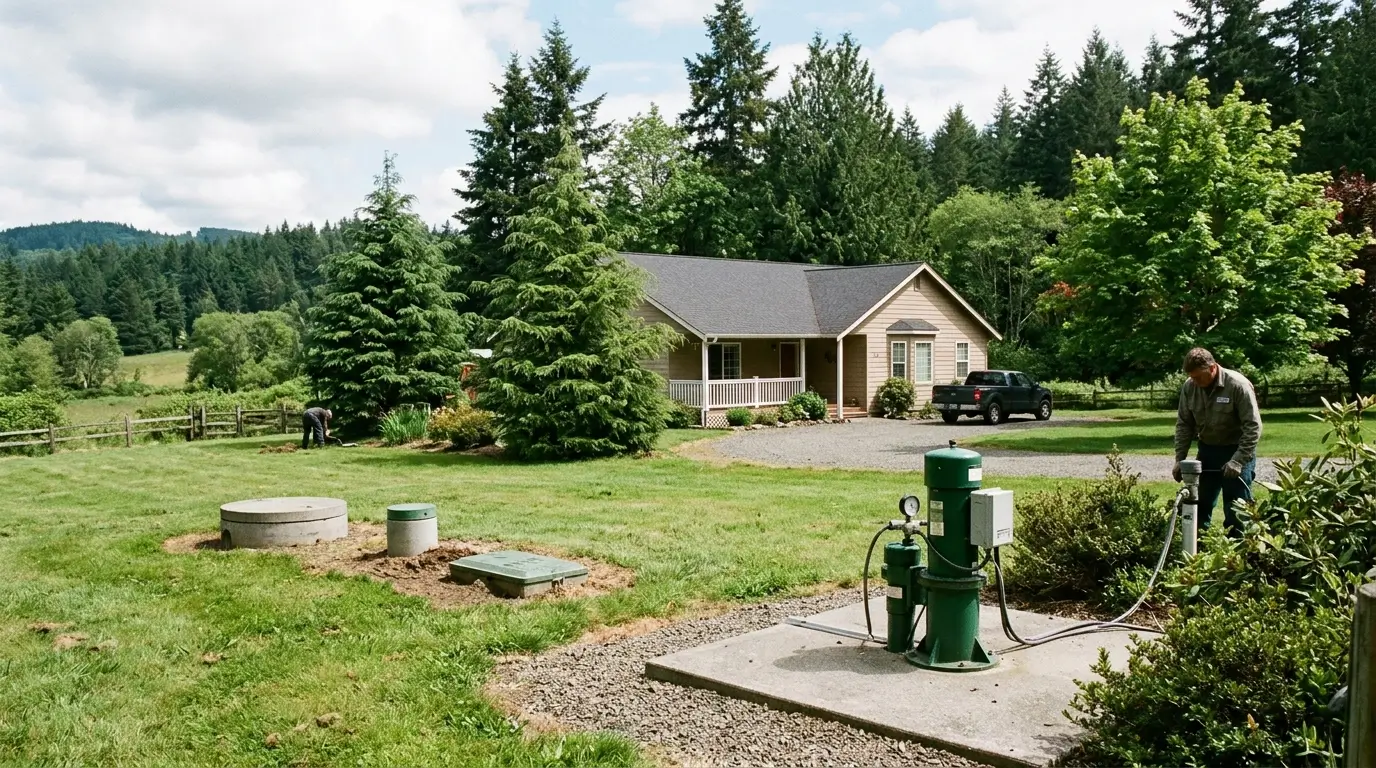
In much of Mason County, a rental home doesn’t come with a sewer line or a water bill. It comes with a well pump, a pressure tank, a septic tank, and a drainfield. Tenants live with all of it, but the law puts the major duties on the owner, and that gap between who uses the system and who is responsible for it is where most surprises happen.
Key Takeaways
Washington’s on-site sewage rule makes the system’s owner responsible for septic operation, monitoring, and maintenance, which in a rental means the landlord.
Tank-and-gravity systems must be inspected at least every three years and all other types annually, matching Mason County’s homeowner report.
Under RCW 59.18.070, repairs must begin within 24 hours of written notice when a tenant loses hot or cold water, including from a failed well pump.
The Department of Health recommends annual well testing for coliform bacteria and nitrate, plus arsenic testing.
Tenant habits affect both systems, so set expectations in a lease addendum.
Start by Confirming What Each Property Has
Homes inside the city of Shelton and other areas with public utilities may connect to municipal water and sewer, but in rural and shoreline communities such as Union, Hoodsport, Belfair, and Grapeview, many homes rely on a private well, a septic system, or both. Confirm each property’s water source and septic type, locate the tank, drainfield, and reserve area, and pull inspection and pumping records. The Department of Health advises septic owners to keep a diagram of the system’s location and a record of maintenance, which also helps whoever owns the home next.
Septic: The Duty Sits With the Owner
WAC 246-272A-0270 makes the system’s owner responsible for operating, monitoring, and maintaining it, and in a rental that owner is you, not the tenant. It requires an inspection by a provider authorized by the local health officer at least every three years for a tank-and-gravity-drainfield system, and annually for all other types, with results submitted to the local health jurisdiction. Mason County’s homeowner operation and maintenance report lists the same frequencies. The county lets homeowners inspect certain system types themselves, but for a rental, a certified specialist is the safer route, since the report carries the owner’s name.
The rule also requires owners to hire an approved pumper when solids and scum levels call for it, repair problems promptly, and keep the system and reserve areas free of structures, paving, roof and footing drains, vehicle compaction, and grade changes. Flow must stay within the system’s approved capacity, so know what household size it was designed around before accepting a large group of occupants.
The Department of Health notes that tanks are usually pumped every three to five years, and more often with a garbage disposal. Selling is changing as well: beginning February 1, 2027, the rule requires a third-party inspection at property transfer, which the local health officer may waive in certain circumstances, and sellers must provide all available maintenance and repair records.
Wells: When the Water Stops, the Clock Starts
A failed well pump means no running water, and Washington law treats that as an emergency. RCW 59.18.060 requires landlords to keep supplied plumbing in reasonably good working order and to provide facilities adequate to supply water and hot water. Under RCW 59.18.070, once a tenant gives written notice, the landlord must begin remedial action within 24 hours where the problem deprives the tenant of hot or cold water, with limited exceptions for circumstances beyond the landlord’s control, and the burden is on the landlord to see the work completed promptly. Line up a pump contractor who answers after hours, and know where the pressure tank, pressure switch, and shutoff valves are.
Testing is the other half. The Department of Health recommends that owners test every year for coliform bacteria and nitrate and also recommends arsenic testing, with one sample in summer and another in winter. The same publication says the owner is responsible for testing and suggests retesting after a flood or repairs. Keep results in the property file and use an accredited lab.
If one well serves more than one home, such as a main house and a second dwelling, different rules may apply. Washington’s Group B public water system rules classify systems by connections, and local boards of health can add requirements, so confirm with Mason County Public Health before renting a second home on a shared well.
Setting Tenant Expectations
A lease can set usage rules, but the inspection and maintenance duties in the state rule belong to the owner. Ask tenants to flush only toilet paper, keep wipes, grease, and chemicals out of drains, and avoid additives and harsh cleaners, since the rule prohibits strong bases, acids, or chlorinated solvents for cleaning a system and allows additives only when the department approves them. Ask them to spread out laundry, keep vehicles off the drainfield, and report slow drains, gurgling, odors, wet or green patches, or a pump alarm.
For wells, ask them to report low pressure, cloudy water, odd smells, or a constantly cycling pump. Because the repair clock starts with written notice, make reporting easy through the tenant portal, and treat any water-loss message as urgent.
Build It Into Your Routine
Treat these systems like any scheduled maintenance item. At onboarding, record each property’s system types, last inspection and pumping dates, and the next due date. Calendar the septic inspection and the annual water test, add septic and well checks to move-in and move-out inspections, and budget for pumping and inspections as predictable costs. Deferring this work is rarely cheaper, as we explain in the hidden cost of deferred maintenance in Mason County, and our rent-ready checklist is a good place to add well and septic items.
Our maintenance program, with documented inspections and coordinated local vendors, is built around exactly this kind of schedule.
FAQ
Who is responsible for septic inspections in a rental?
The system’s owner. Under WAC 246-272A-0270, the owner must operate, monitor, and maintain the system, including required inspections, and in a rental that is the landlord.
How often must a septic system be inspected in Mason County?
At least every three years for a tank-and-gravity-drainfield system, and annually for all other types, per the state rule and Mason County’s homeowner report.
How fast must I act if the well pump fails?
After written notice, begin remedial action within 24 hours when a tenant loses hot or cold water, except where circumstances are beyond your control.
Should I test the well water at a rental?
The Department of Health recommends annual testing for coliform bacteria and nitrate, plus arsenic testing, and says the owner is responsible. Check with Mason County for any local requirements.
Know Your Systems Before They Fail
Wells and septic systems are manageable on a schedule and expensive as a surprise. Knowing what each property has, who is responsible for what, and how quickly a water loss must be addressed turns a rural rental from a risk into a routine.
If you own a home with a well, a septic system, or both and want the inspections, testing, and vendor calls handled on a calendar, our Shelton property management team coordinates preventative maintenance across Mason, Thurston, and Grays Harbor Counties.